
Compiling the database


Identifying the emigrants
The starting points for building the core database of the emigrants and their families included:
- lists of family members and indentured servants brought into East Jersey in 1683 and 1684;
- other free emigrants identified from records of property transactions and wills in the New Jersey State Archives (NJSA);
- prisoners sentenced to transportation identified in the Register of the Privy Council of Scotland (RPCS); and
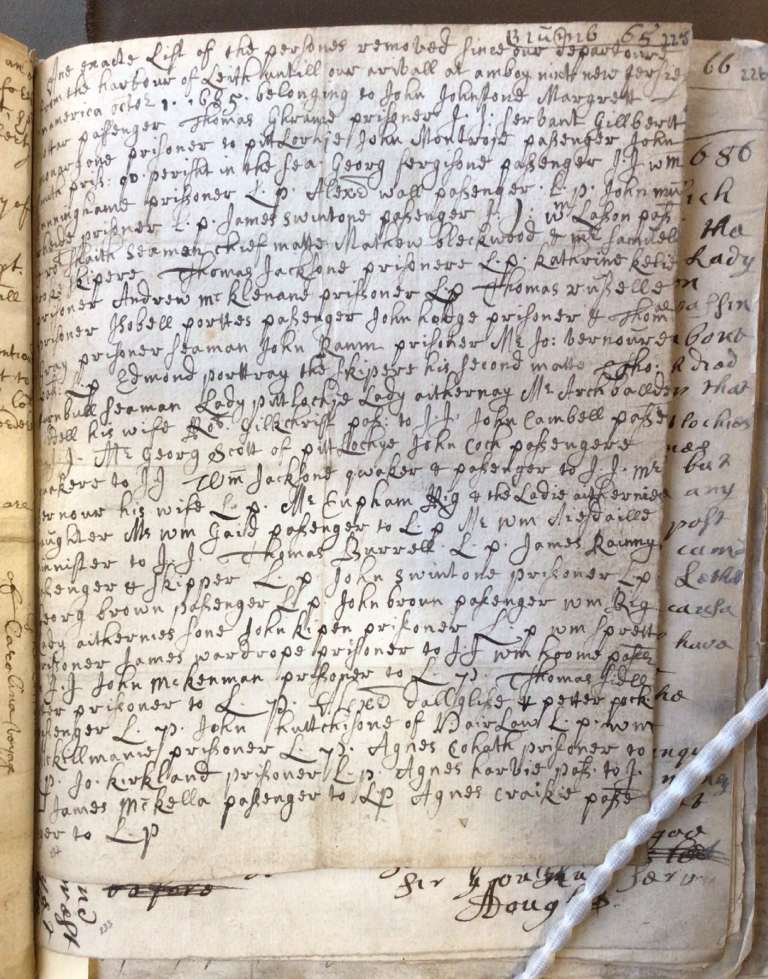
- a list of those who died aboard the Henry and Francis in 1685, contained in a document amongst the Wodrow manuscripts in the National Library of Scotland.
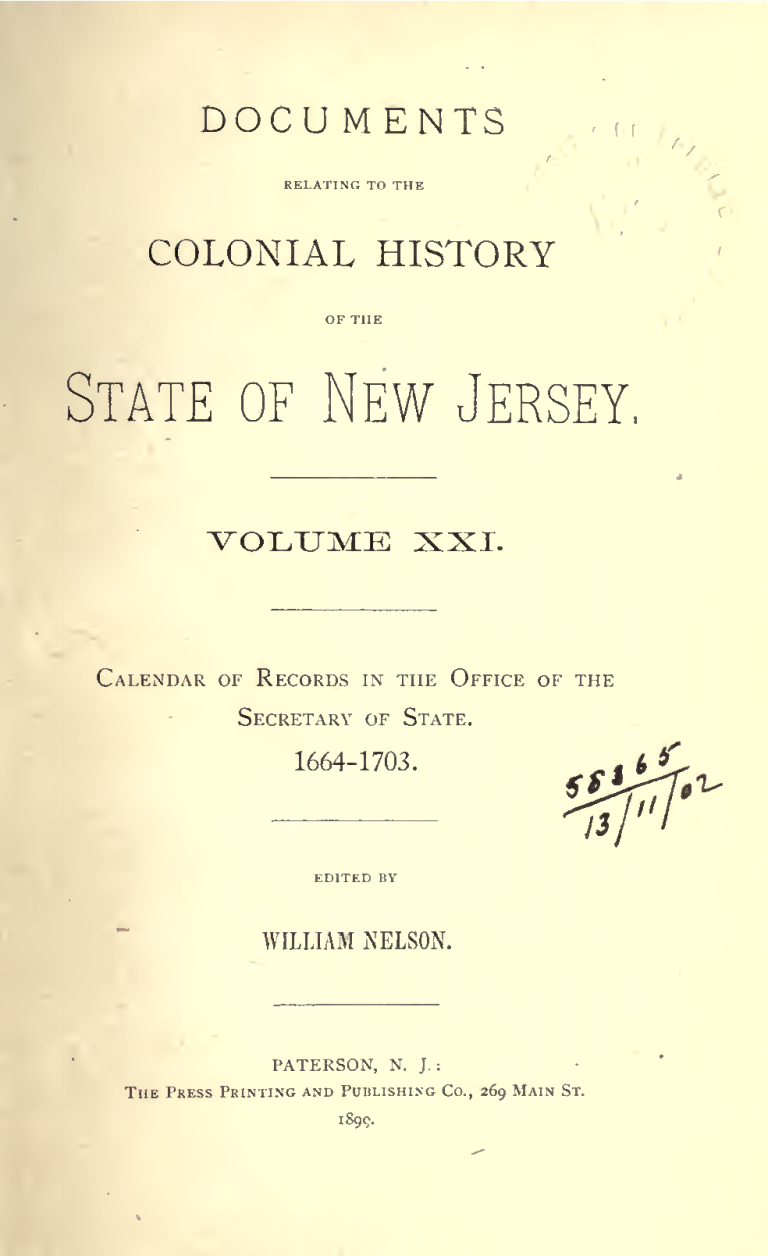
Principal New Jersey sources included William Nelson’s Calendar of Records in the Office of the Secretary of State, 1664-1703 (1899) and Calendar of Records and Calendar of New Jersey Wills, Volume 1, 1670-1730 (1901), and the NJSA’s digitised Early Land Records, 1650-1900s.
Various lists such as David Dobson’s Scottish Quakers and Early America proved helpful in checking and confirming the presence or otherwise of emigrants.
I drew on a variety of other sources to supplement these lists, including local histories (e.g., those available through the Internet Archive) and genealogical websites (services such as Ancestry and Family Search) and online communities (e.g., the archived Rootsweb site). These sources typically require checking, but can provide valuable leads on individuals and their families. They may also point to additional verifiable sources which may not easily be found using other methods.
In the interests of sharing, all sources should be freely available, though some will also lie behind paywalls.


Some exclusions
There were several emigrants such as Thomas Edgar, Patrick Imlay and John Ireland who may have arrived on ships arriving between 1683 and 1685 but for whom evidence is lacking on this. I coded them as ‘later free emigrants’. Quantitative analysis in the dissertation concentrates on the population known to have arrived between 1683 and 1685.
I excluded from my analysis a few English and Irish emigrants as not ‘Scots’ though they have been treated as such by other authors. You will find them, however, in the database. Examples include carpenters James Marshall and his family from Northumberland, Peter Kinnan imported by William Docwra from Ireland, and Quaker miller John Loufborrow who arrived in East Jersey independently.
Some 50 servants were reported to have been imported by David Mudie in 1688 aboard the Unity but they do not not turn up in other records. It is possible also that a few of the 22 women who were married to Scots for whom there is no record of maiden name or origin were amongst the original emigrants.

The emigrants' back stories
Subsequent research filled out the family contexts and back stories of the emigrants. This drew not only on some of the sources already mentioned but also, for example, on:
- genealogies, such as the Red Book of Scotland, Patrick’s People and individual family histories;
- vital event records (Old Parish Registers on Scotland’s People; Digest of Quaker Births, Marriages and Deaths);
- other records held by National Records of Scotland, including Deeds and Gifts and Deposits;
- Covenanter sources: e.g., lists of Dunnottar prisoners, Mark Jardine’s Book of Martyrs website, Scottish Covenanters collection (Find My Past); and
- burgess lists published by the Scottish Records Society and others.
These were supplemented by secondary sources such as Burnet and Marwick’s history of Quakers in Scotland and Wodrow’s History of the Sufferings of the Church of Scotland. I made extensive use of internet searches to fill gaps, e.g., by trying combinations of surname variants and locations.

Identifying what became of the emigrants
Many factors affect the extent to which it is possible to trace what became of the emigrants, given limitations in the available records and the likelihood that many individuals were unlikely to have been recorded after their arrival. That many emigrants were single meant that if they did not marry and have children, they would be less likely to leave any markers, such as gravestones or family bibles. Single people were also more likely to move to other areas in search of better prospects.
That said, East Jersey sources are very helpful in tracking, especially volumes in the Documents relating to the colonial and revolutionary history of the State of New Jersey series published by the New Jersey Historical Society (NJHS). These provide original records, or abstracts of them. More recently the digitised records available through the Early Land Records project allow more information to be gleaned through reading the original documents, e.g., the names of witnesses to deeds. There are only scattered marriage and burial records in East Jersey before the 1730s when church records became more common. Wider reading of the East Jersey literature and family histories has provided pointers and I have made extensive use of internet searches, as in looking at the roots of the emigrants in Scotland, seeking always to triangulate evidence.
USGenWeb and Family Search research guides were especially helpful in identifying and accessing records beyond New Jersey. Neighbouring states have collections of original records analogous to those of the NJHS.
Last recorded traces of Scots emigrants

Tracking the emigrants
Of the 415 adult emigrants who left Scotland between 1683 and 1685 and survived their voyage, 53% were indentured servants, 25% were prisoners and 22% free migrants. Of those where subsequent records exist, just under a quarter are known to have died after 1702. It is possible to trace a further third after their arrival but for whom there is no will, gravestone nor other note of death.
This violin plot illustrates the variations in the last known traces of the 1683-1685 emigrants. For the years of last trace for each of the main categories, the plot uses the earliest, first quartile, median, third quartile, and latest years. This shows the extent to which indentured servants and transported prisoners disappear from the records in the early years of settlement, especially when compared to the free emigrants.
Identifying others involved
Identifying others involved in the East Jersey venture required access to a range of sources, both Scottish and New Jerseyan, beyond those already cited. For the wider set of East Jersey Proprietors and investors who never travelled, the digitised land records from the New Jersey State Archives and the NJHS volumes were again invaluable.
George Scot of Pitlochie’s Model of the Government of the Province of East-New-Jersey provides over 100 pages of letters from emigrants to East Jersey who arrived in 1683 and 1684, thereby allowing identification of family members, friends and associates with whom they corresponded. Names of the agents who promoted the East Jersey venture are contained in this and other contemporary promotional literature. There is little other relevant correspondence that survives.
Deeds in Scotland and New Jersey provide information about business partners and associates, debtors and creditors. In all, I reviewed over 130 Scottish deeds, mainly registered between 1681 and 1687 relating to the emigrants and absentee landowners, plus some of their close family members, agents and other individuals significant in the East Jersey story. Most relate to property and/or credit.
Witnesses recorded in baptismal records in Scotland and wills in both Scotland and New Jersey provide valuable evidence on family connections.
Online searches identified many relevant family histories, of variable robustness. Very informative examples include Gifford on the Falconers of Halkerton, Ormiston on the Ormiston of Teviotdale, and Torrance on the McClellans of Galloway. Other, less reliable publications provided leads and sources for checking. A further limitation of these sources is that they tend to concentrate on single male lines and do little to explore female lines and how kinship may build across families and generations. However, overall it was possible to bridge many such cases and reveal how they were connected in ways not previously reported.