


From a merchant family in Prestonpans
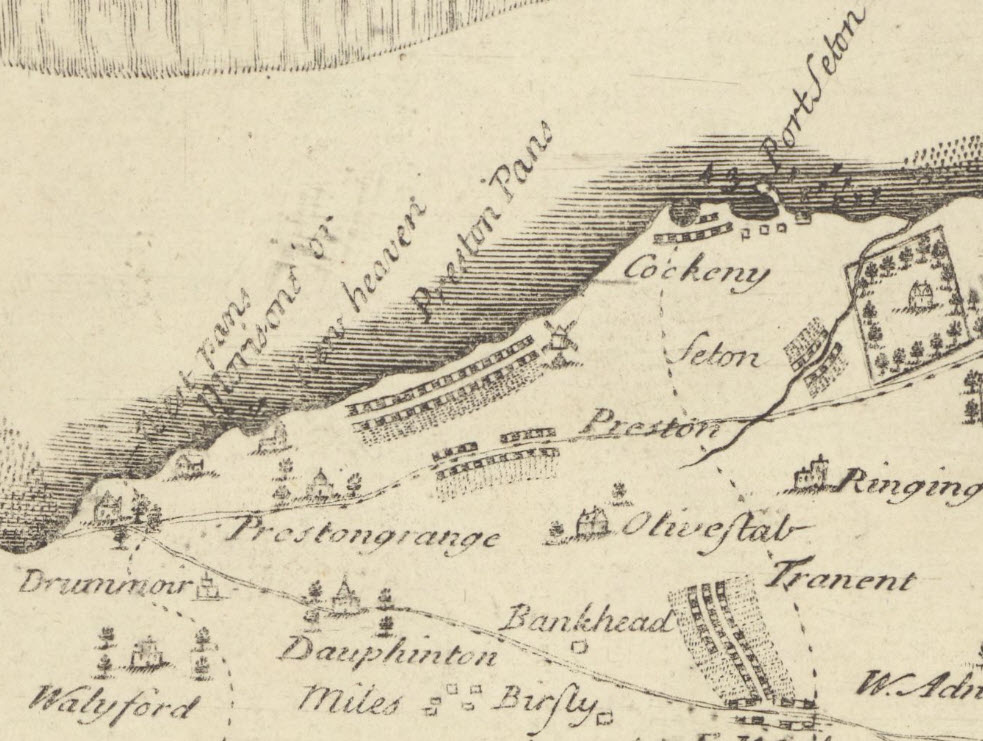
Gawen Drummond was born in 1659 in Prestonpans, East Lothian, the son of merchant Robert Drummond and Isabel Melvine. He was baptised on 19 June 1659, with George Makclaine and George Wallace acting as witnesses. By 1682, he was working as a merchant in Prestonpans. His elder brothers James and John were also merchants, John later becoming well-known as John Drummond of Newton, a prominent director of the New Mills Manufactory in Haddington and of the Company of Scotland which promoted the Darien expedition) and Alexander, manager of the salt works in Prestonpans for the local laird, William Morison of Prestongrange.
An early 'fractioner'
Gawen was one of the earliest of the so-called ‘fractioners’ to buy a share of East Jersey acquired by the Scots Proprietors. On 20 February 1681/82, he purchased the rights to 500 acres from his kinsman John Drummond of Lundin.
Accompanied by his nephew Robert and probably by his first wife and young children, he departed from Leith on 11 June 1684 aboard the Shield of Stockton and arrived at the Patuxent River, Maryland, on 29 September. From there they either went overland or coastal vessel to Perth Amboy.
Establishing 'Locharbor'
Gawen established an estate he called Locharbor in Monmouth County. In the “name & behalfe of the Governor & proprietors of East new Jersey”, he first arranged the purchase of land from three Lenni-Lenape sachems, Wanamassa, Wallammassekaman and Waywinelunce. The land was known to them surrounding Ulickaqueko, a “great pond”, bounded by a pine hill and a brook and tracts previously sold to Thomas Potter and Samuel White.
The price was one gun, five matchcoats (heavy winter coats), one kettle, and two pounds of powder. This was the procedure drawn up under the Concessions and Agreements of the colony whereby individual settlers were prohibited from buying land directly from Native Americans as sovereign individuals. Purchases had to be made in the name of the Proprietors, who would then issue warrants to develop the land, once cleared, to settlers. In Gawen’s case, this occurred on 19 March 1688/89, when he was granted a warrant to lay out 680 acres where he was “already settled”. Of this allocation, 80 acres was for his nephew Robert. In December 1688, Gawen purchased the 30-acre of headland of James Kilgour and in March 1688/89, a further 30 acres from James Crighton.
Clerk of the County Court
Gawen played a role in public life. In March 1701, he was Clerk of the Monmouth Court of Sessions, when dramatic events unfolded. During a case against pirate Moses Butterworth, a local mob seized Governor Andrew Hamilton, two deputies, the two justices, the Attorney General and Secretary as well as Gawen himself. This was during a period of opposition to the proprietorial rule of East Jersey and a factor precipitating the merger of East and West Jersey the following year.
Death and family
Gawen died sometime before 31 August 1724 when administration of his estate was granted to his son Gawen. An inventory dated 2 August 1728 valued his possessions at £136 14s 10d and included books and seafaring instruments. It is believed that he was buried at the Friends Meeting House Burial Ground in Shrewsbury, Monmouth County, although no gravestone survives.
His second wife was Mary Layton or Lawton, believed to be the daughter of William Layton and Violet Blackman, and born in Rhode Island or Middletown around 1668. Gawen’s children were Gawen, Robert, John, Isabel, Sarah, and Rebecca.