John Cockburn (c.1659- aft.1712)
John Cockburn was a mason from the Borders who emigrated as an indentured servant and was one of the very first freemasons in Colonial America.
He emigrated aboard the Shield of Stockton, leaving Leith on 3 July and landing at the Patuxent Rover, Delaware on 29 September. From there he and all the other passengers made their way to East Jersey, overland or by boat.
Cockburn was imported by merchant John Campbell on behalf of Captain Andrew Hamilton who was later, in 1686, sent over by the Scots Proprietors to investigate how the colony was being run. Hamilton may have been a freemason too. One clue is that Hamilton chose advocate Sir John Harper of Cambusnethan to be the primary witness at the baptism of his son John in Edinburgh in 1685. Harper had been a leading member of the Lodge since joining in 1670 as a ‘speculative’ mason as distinct from an ‘operative’ mason like Cockburn.
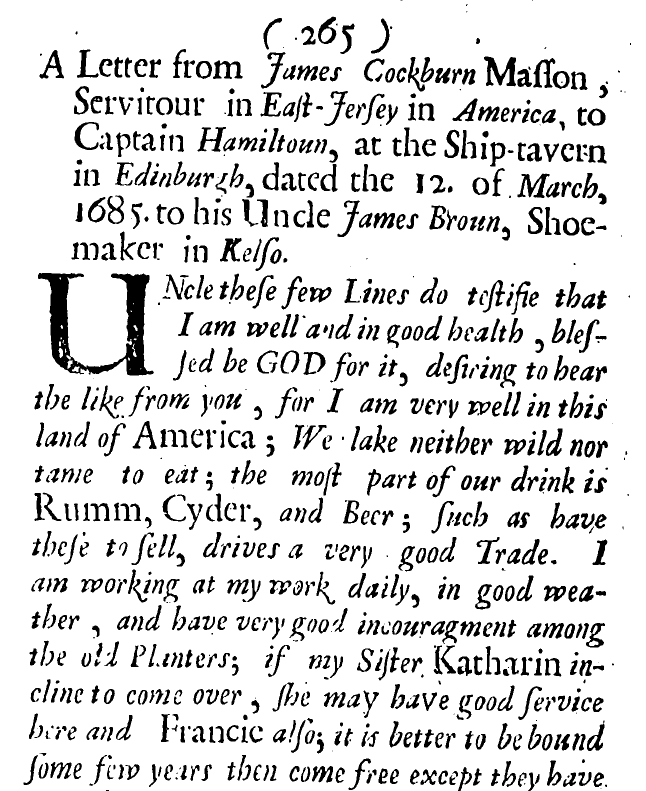
George Scot, in his promotional tract, The Model of the Government of the Province of East-New-Jersey, made particular use of two letters that Cockburn sent to Scotland in March 1685, within six months of his arrival. Scot’s intent was to counter accusations that accounts of East Jersey as a destination for emigrants were overblown by unnamed ‘Gentlemen’ to their own advantage, not that of the working man.
In these letters to his uncle James Brown, shoemaker, and George Fae [or Fall], a mason and freemason, both in Kelso, he extolled how pleasant a country he had found East Jersey to be, and how much work there was to be had by masons. He hoped his sister Katharin would join him and perhaps another relation called Francie.
Cockburn was Presbyterian but not a committed Covenanter. He expressed concern in his letter to his uncle, commenting that, “there is nothing discourages us more than want of Ministers” and hoped some would soon arrive from Scotland.
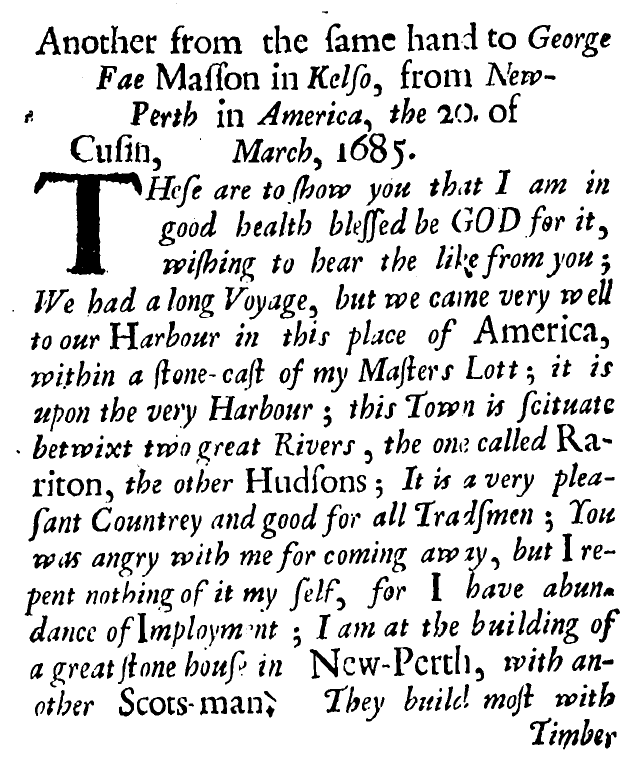
Cockburn found employment on his arrival alongside fellow immigrant John Hume, commissioned by merchant, David Mudie, to build ‘a big Stone house’. He continued to find plenty of work not just in East Jersey, such as repairing the Governor’s house in 1692, but also in New York where he was recorded as living in January 1695.
As an indentured servant he was entitled to a grant of ‘headland’ at the end of his contract and he petitioned the Board of Proprietors for this in August 1686. As skilled worker, he was entitled to a shorter term indenture and possibly a larger grant of land than the standard 30 acres.
Over time, Cockburn accrued more of a landholding in East Jersey, buying up the headlands of other indentured servants, such as those of Robert Anderson and brothers George and John Sharp brothers in 1694. Many preferred to pursue their trade unencumbered by property they would have to farm. In 1695 he held 220 acres around Newark and had property dealings in Perth Amboy.
John Cockburn is regarded as one of the first freemasons in Colonial America, along with the Quaker John Skene from the Newtyle family in Aberdeenshire who emigrated to West Jersey in 1682 and served as the colony’s Deputy Governor until 1688. Skene had been a member of the Aberdeen Lodge along with several other freemasons involved in the East Jersey project, including John Forbes who emigrated then returned home when he succeeded his brother to the family estate of Boyndlie in Tyrie, Aberdeenshire.
See database entry for John Cockburn
Read more
Freemasons
Stevenson, David, The First Freemasons: Scotland’s Early Lodges and Their Members (Aberdeen University Press, 1988), p116
Use of correspondence in promoting emigration
George Scot, The Model of the Government of the Province of East-New-Jersey in America (Edinburgh: John Reid, 1685), pp265-267 (reprinted in William A. Whitehead, East Jersey under the Proprietary Governments, 2nd edition, Newark: M.R. Dennis, 1875)
Cameron Alasdair Macfarlane, ‘“A Dream of Darien”: Scottish Empire and the Evolution of Early Modern Travel Writing’ (unpublished Doctoral thesis, Durham University, 2018)
Stevenson, David, The First Freemasons: Scotland’s Early Lodges and Their Members (Aberdeen University Press, 1988), p116
George Scot, The Model of the Government of the Province of East-New-Jersey in America (Edinburgh: John Reid, 1685), pp265-267 (reprinted in William A. Whitehead, East Jersey under the Proprietary Governments, 2nd edition, Newark: M.R. Dennis, 1875)
Cameron Alasdair Macfarlane, ‘“A Dream of Darien”: Scottish Empire and the Evolution of Early Modern Travel Writing’ (unpublished Doctoral thesis, Durham University, 2018)