John Reid of Hortencie (1655-1723)
John Reid, the gard’ner
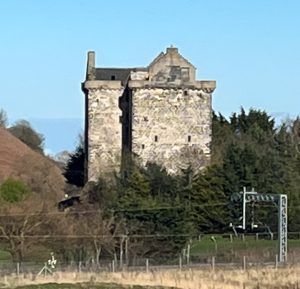
John Reid, author of The Scots Gard’ner, was born in 1655 at Niddry Castle near Kirkliston in West Lothian, where both his father and grandfather were gardeners to the Seton family. He was apprenticed in 1668 to Andrew Wardlaw, a merchant in Edinburgh, but by the 1670s had turned decisively to horticulture. His early career was spent in some of the great gardens of Scotland’s landed estates – first as under-gardener to Quaker Hew Wood on the Duke of Hamilton’s estate, then as gardener to James, Earl of Perth at Drummond Castle, and later to Sir George Mackenzie of Rosehaugh at his estate at the Shank near Gorebridge, Midlothian.
Reid became a Quaker while in Hamilton and married Margaret Miller at the Friends’ in 1678. Around this time he began writing The Scots Gard’ner, the first practical guide to gardening and horticulture published in Scotland. It was issued in Edinburgh in 1683, shortly after his departure for East Jersey. The book distilled his knowledge, providing advice on soils, kitchen and flower gardens, orchards, and the setting-out of grounds.
‘Overseer’ for the first emigrants
John had gained the confidence of influential employers and also leading Quakers including Robert Barclay, prime mover in the East Jersey venture. This resulted in his appointment as one of two ‘overseers’ appointed by the Scots Proprietors to travel with the first shipload of emigrants aboard the Exchange of Stockton which left from Aberdeen in August 1683. Their role was to manage the initial settlement, ensure that provisions and resources were properly distributed, and supervise early agricultural activity. He was indentured for four years but, like his fellow overseer John Hamton, he was granted an salary of £25 and provided with a house and livestock. Hamton was also a gardener and a Quaker, gardening being an activity of great appeal to the early Quakers as a source of spiritual meaning and a way to contribute to society.
Surveyor, landowner and public official
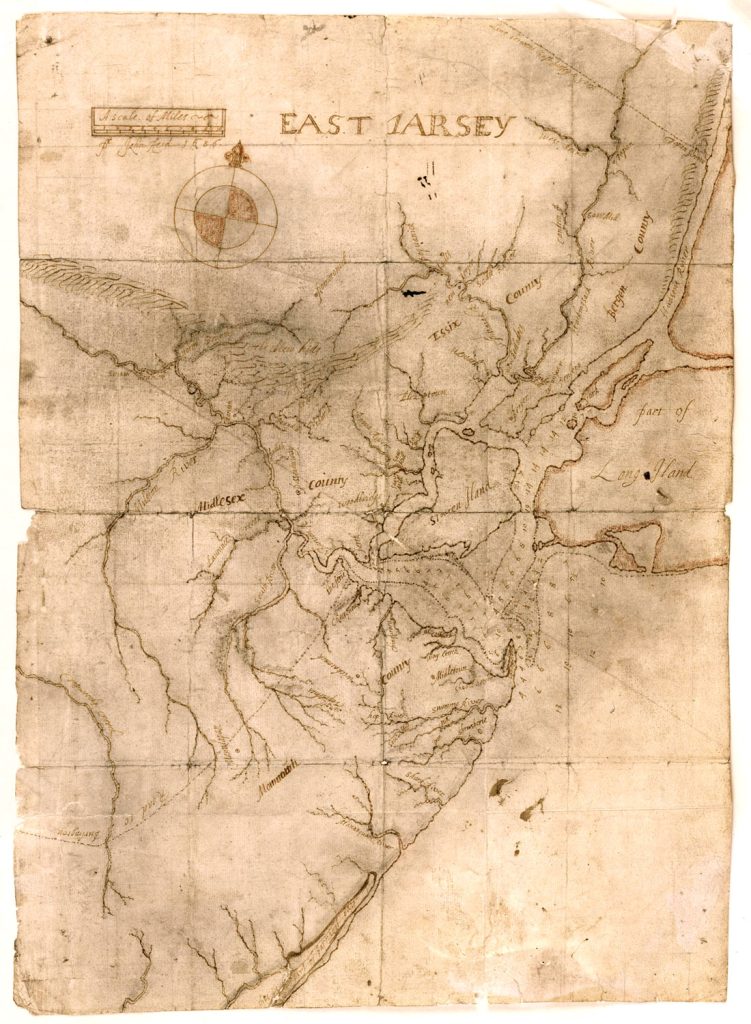
Gardening was a highly skilled occupation requiring going beyond botany to encompass mathematics, physics and the science of weather. Not only did Reid make a practical contribution to the laying out of land and cultivation but his skills led him to be appointed Surveyor-General of East Jersey. He helped to establish the system of surveys and boundaries that underpinned East Jersey’s land administration and later assisted in defining the line dividing East and West Jersey, work for which his accuracy and fairness were commended.
Gardening was a highly skilled occupation requiring going beyond botany to encompass mathematics, physics and the science of weather. Not only did Reid make a practical contribution to the laying out of land and cultivation but his skills led him to be appointed Surveyor-General of East Jersey. He helped to establish the system of surveys and boundaries that underpinned East Jersey’s land administration and later assisted in defining the line dividing East and West Jersey, work for which his accuracy and fairness were commended.
Reid also played a role in the governance of East Jersey as a member of the Board of Proprietors from 1692, serving as proxy for William Dockwra, holding this position until 1705. He also served as a County Court judge and as commissioner of roads.
Religion and family
Reid was one of the Quakers who, following the criticisms of George Keith over doctrinal practices left for the Church of England. He received his first Anglican Communion in 1703 and remained a communicant thereafter.
Reid died in 1723 at Freehold, Monmouth County and was buried at Topanemus, at the Old Scots Burying Ground. His library, inventoried after his death, reflected both his scientific and literary tastes, containing books on law, theology, astronomy and history, as well as Scotland’s sovereignty asserted by Sir Thomas Craig and the novels of Aphra Behn.
He had travelled in 1683 with his wife Margaret to East Jersey with three daughters under four. Tragedy struck when the youngest, Margaret died within three months of their arrival, and six months later another child was stillborn. Two years on they had a son, John, who trained as a lawyer and practised in Westchester, New York. Their daughters were schooled in Philadelphia and the elder, Anna, married John Anderson, the master of the Unicorn, one of the ships that had been part of the Darien expedition in 1698, and later a prominent New Jersey politician. Their other daughter, Helen, married Reverend John Bartow. He had been sent in1702 as a missionary by the Society for the Propagation of the Gospel in London and two years later became Anglican rector of Westchester.
Other close kin also emigrated in 1683: two of John’s brothers: James who travelled as a free emigrant with his wife and two children, and George, an indentured servant, as well as John’s brother-in-law, James Miller of Gartshore and wife, Margaret Robinson.