David Jamieson (1659-1739)

David Jamieson was born in March 1659 in Linlithgow, West Lothian, to David Jamie and Bessie Tod. He grew up in a Covenanter household and learnt the tailoring skills of his father’s business.

The authorities accused him of being a member of the Covenanter army at the Battle of Bothwell Bridge on 22 June 1679. The following January, he was declared an outlaw and his belongings confiscated for failing to appear on a charge of treason and rebellion. Regarded as able by his peers, he may briefly that year have studied in Utrecht, Netherlands, supported by Covenanter funds raised at conventicles or in other ways.

By 1681, however he was back in West Lothian and a leading member of a Covenanter sect known as the Sweet Singers, or Gibbites (as named after their leader, John Gibb). In May that year, he and others were arrested near Wolf Craigs in the Pentland Hills near Edinburgh and imprisoned in Canongate Tolbooth. They had rapidly developed notoriety for their extreme views, not only in the eyes of magistrates but also fellow Covenanters for whom their rejection of the formal church and its ministers was anathema. They led very austere lives and took to periodic fasting, which led them to be accused of manic behaviour.

Field preaching engraving

Front page of ‘A Blasphemous and Treasonable Paper Emitted by the PHANATICAL under-subscribers’, (Edinburgh, 1681)
‘A Blasphemous and Treasonable Paper Emitted by the PHANATICAL under-subscribers’, (Edinburgh, 1681)

Despite being one of the authors of an extremely radical religious manifesto produced at the end of May, David and other Sweet Singers were subsequently released. However, he was again in prison in November for failing to pay a fine for absenting himself from parish church services. He appears again in the penal records on 4 January 1683, amongst Linlithgow residents accused of religious disorder.

In early May 1684 David was arrested, having been on the Fugitive Roll, and on 16 May he was formally banished by the Privy Council and ordered to be transported “to the Plantations in America”. He could have been shipped to South Carolina with other merchants but ended up the responsibility of Dr George Lockhart, the New York merchant with a property interest in East Jersey who also agreed to take two other Sweet Singers, John Gibb and Alexander Montgomery (or Monteith), along with six other prisoners.  Lockhart’s ship, the Seaflower left Leith on 21 August 1684 heading for New York.

There David was sold as an indentured servant to Josiah Clarke, Anglican chaplain of the New York Fort. Clarke regarded him with promise and he was allowed “to teach school to redeem himself”. He began to train in law and in 1690 was a legal clerk to Matthew Clarkson, Secretary of New York Province. It was not long before he was appointed Clerk to the Council of New York, 15 April 1691. He held the post until 1698 when he was dismissed by Governor Lord Bellomont, who accused him of having been condemned to death in Scotland and of atheism and bigamy.

This was not, however, to be the end of his career in public office. In June 1701, he was appointed deputy provincial Surveyor-General and in 1711 he became Chief Justice of New Jersey, serving until 1723. In June 1712, he also became Recorder of New York City with significant legal responsibilities. In January 1720 he was sworn in as New York Attorney General.


The old city hall, Wall Street, watercolour from the original drawing by David Grimm
The old city hall, Wall Street, from the original drawing by David Grimm. New York Public Library Digital Collections

He practised independently as an attorney and was one of the founders of the New York Bar Association. In 1707, he was one of three attorneys defending Francis Makemie, a Scots-Irish minister, for preaching without a licence, a case notable in the annals of Presbyterianism in the USA. David himself was no longer Presbyterian, having become Anglican and been chosen as a vestryman (like an elder in the Church of Scotland) in the Trinity Church in Lower Manhattan.

David was active in the property market mainly in New York. In June 1696, he was a partner in a land patent in Harrison, Westchester County and the following year in a consortium which secured what became known as the Great Nine Partners Patent in Dutchess County, though the latter investment he never saw fully realised. Later in 1697  he was party to a land grant of 1,200 acres in Deerpark, Orange County. On 11 November 1703, he sold land in Piscataway, New Jersey, to Scottish immigrant Thomas Grubb and his wife.

David married Anna Maria Hardenbroeck on 7 May 1692 at the Collegiate Church in New York. Anna Maria was niece of Margarete Hardenbroek, a leading merchant in New York in her own right as well as partner to her second husband, Frederick Philipse. Philipse was involved in slave trading and privateering including as a sponsor of William Kidd’s piratical activities with the Adventure Galley in the Indian Ocean in 1695.

David and Anna Maria had two children: Elizabeth and William. After Anna Maria’s death he married Joanna Meech on 16 January 1703. He died on 26 July 1739 in Manhattan and was buried there.


See database entry for David Jamieson


Jean Moffat (c.1666-c.1749)

Jean Moffat was born in about 1666 at Netherbarns just outside Galashiels, the daughter of James Moffat, tenant farmer and determined Covenanter. Jean was perhaps even stronger her beliefs and persistently refused to attend the services of the local minister. In consequence her father was fined 1,000 merks, for failing in his legal responsibility to ensure religious conformity by his family and farm workers. Her father was already in trouble, accused of harbouring rebels and placed on the Fugitive Roll. Their house was raided by dragoons and goods and livestock carried off.

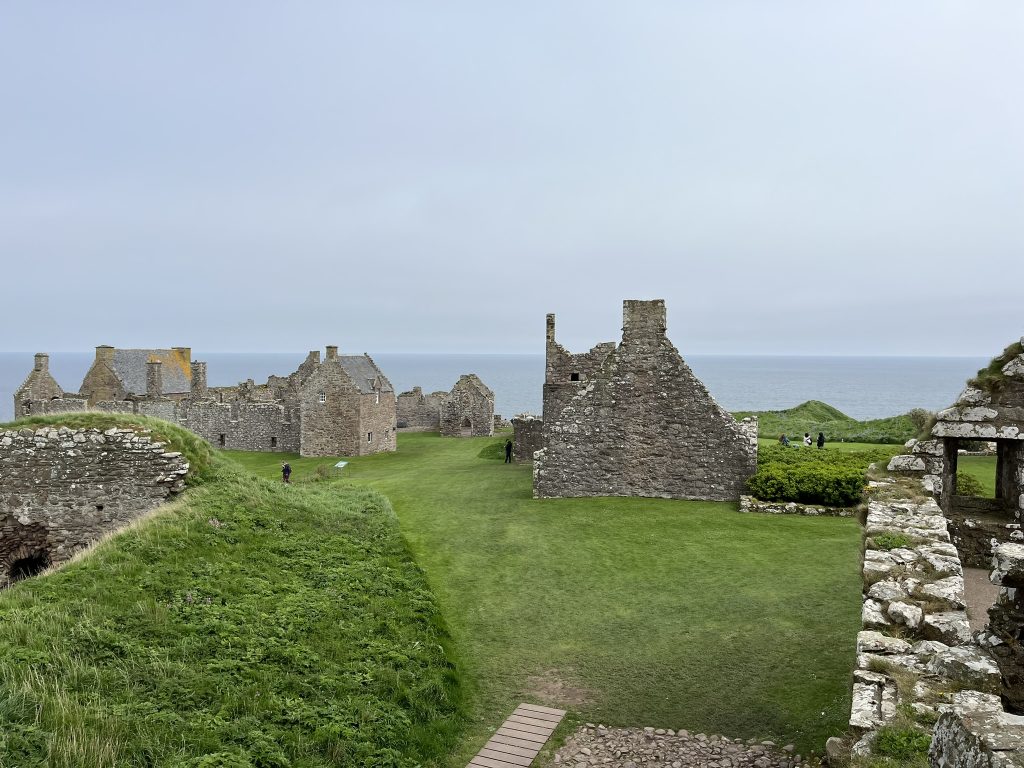
Dunnottar Castle, May 2023

On 18 May 1685, following the authorities’ round-up of many of the most resolute Covenanters, Jean found herself in Burntisland, Fife amongst the 45 women prisoners to be sent to Dunnottar Castle in Kincardineshire. There she was held about 80 days in cramped, filthy conditions housing over 160 people. By mid August, Privy Council members were impatient to remove the most recalcitrant Covenanters and on 18 August, Jean was banished for refusing oaths of allegiance to the King and opposition to taking up arms in rebellion and given to George Scot of Pitlochie for transportation.

The 'Whigs Vault' in Dunnottar Castle
The so-called ‘Whigs Vault’ in Dunnottar Castle

Once aboard the Henry and Francis lying off the port of Leith, she was one of 28 signatories of a testimony protesting the banishment of the Covenanters. The ship left on 5 September 1685 and arrived at Perth Amboy on 7 December with Jean amongst the survivors of the disease-ridden voyage.

Jean was amongst the party of Covenanters who decided to leave East Jersey and head for New England where they hoped to encounter English settlers who held sympathetic religious views. By 1686, she was living in Waterbury, Connecticut, where she married John Fraser [or Frazer], a fellow Dunnottar prisoner transported on the Henry and Francis.

John, a university graduate from the Fraser of Pitcalzean family, Nigg in Ross-shire, had earned a living in London as a writing master where he had been arrested in December 1684 for attending a house conventicle. Once in Waterbury he was licensed to preach by local Congregationalist ministers. This stood him in good stead when he and Jean returned to Scotland after the accession of William and Mary and the consequent resumption of religious authority on the part of the Presbyterian Church. Jean was then able to visit with her father who was once more living on his farm at Netherbarns.

John Fraser was ordained as minister of Glencorse parish near Penicuik, Midlothian in December 1691, before transferring to Alness in Easter Ross in 1695, pressed by the General Assembly to move to help address a shortage of Gaelic-speaking ministers.

John Fraser wrote a memoir of his experience as a Covenanter prisoner which was used by Robert Wodrow in his History of the Sufferings of the Church of Scotland, in the process firmly planting the tales of Dunnottar Castle and the voyage of the Henry and Francis in popular Covenanter memory.

Jean and John had five children after their return to Scotland: Jean, James, Katherine, Isabel, and John. Their son James trained for the ministry and later (1736) also became minister of Alness. James’s collected works were published in 1834, with the addition by the editor of an account of his and his parents’ lives.

Following the death of John Fraser in 1711, Jean married widower George Gordon, minister of Cromarty in 1714. There she was regarded as an attractive woman though known  – not to her face – as ‘Luggie’, as it was rumoured that she had suffered the fate other banished Covenanters of having her ears clipped. Hugh Miller relates in his Scenes and Legends of the North of Scotland (1835), his history of Cromarty, that this was not the case although she always kept her ears covered. Jean may have outlived George Gordon, who died in 1749.


Text from a Short Account of the Author (Rev. James Fraser of Pitcalzian), 1834
Extract from collected works of Rev. James Fraser referring to the author’s father, John Fraser.

Spoon given by Jean Moffat to her daughter Katherine Fraser
Spoon given by Jean Moffat to her daughter Katherine Fraser. Maker: attributed to Hugh Ross of Tain, c.1740? Source: Estelle Quick, ‘A Big Story from a Little Spoon’, The Finial, Vol.21/05, May/June 2011 (Silver Spoon Club of Great Britain)


See database entry for Jean Moffat


See database entry for John Fraser


Andrew Paterson (1659–1746)

Andrew Paterson was a Covenanter who was transported in 1685 and made his way to Connecticut where he settled and had a family.

Andrew Paterson [or Patterson] was born in 1659 in Hamilton, Lanarkshire. He was firm in his Covenanting beliefs and may have been in the Covenanter army at the Battle of Bothwell Bridge in 1679.

In 1685, in the light of the expected Argyll Rising, the authorities considered him a threat, brought him under arrest and held him in Glasgow Tolbooth. On 20 May he refused the oath of allegiance to the Crown but though he “remained obstinat” he avoided the formal sentence of banishment unlike some of the others. This did not however, prevent his later transportation.

He was immediately sent to Burntisland to join other Covenanter prisoners and thence to Dunnottar Castle, where he was held until early August. The group was then taken to Leith, arriving on 17 August and soon after placed aboard the Henry and Francis. There he was one of the signatories of the testimony protesting their enforced exile on their refusal to acknowledge the King, not Jesus, as head of the church, “a sworn enemy to religion, an avowed papist whom by our covenants we are bound to withstand and disown”.

Patterson was one of the survivors aboard the Henry and Francis, arriving in Perth Amboy on 7 December 1685. 

A life in Connecticut

In early 1686, he walked over 90 miles to Stratford, Connecticut, accompanying Robert McEwen and ten other Covenanters who wished to find somewhere to live with people were sympathetic to their religious beliefs. They were also under threat for forced indenture if they stayed in East Jersey, though this was resolved in favour of the Covenanter transportees in late February 1686.

Four years later, Paterson married Elizabeth Peat [or Peet], granddaughter of an English Puritan emigrant, John Peat from Derby. The Patersons went on to have seven children: Sarah, Charles, William, Elizabeth, Hannah, Mary, and John. In late 1691 he acquired 16 acres on the west side of Stonibrook Hill in Stratford, giving him the status of a town proprietor. His son John was one of the first graduates of Yale College in 1718.

Paterson served as Town Sergeant for a spell, responsible for maintaining public order and carrying out orders of the town’s governing body, including serving warrants, summoning individuals to court, and making arrests. He was also a School Committeeman in 1718, contributing to the oversight of the local school.

In November 1738, along with his sons William and John, by then also town proprietors, he was granted a portion of undivided land in Fairfield.

Andrew Paterson died, aged 87, on 2 December 1746 and was buried in the Old Congregational Burying Place in Stratford.


See database entry for Andrew Paterson


Andrew Paterson gravestone, Fairfield
Andrew Paterson gravestone, Fairfield – photo by Steven Smith (FindaGrave)
Read more

Elisha G Patterson, Andrew Patterson, of Stratford, Conn., and the First Four Generations of His Descendants (privately printed, 1892) 

Elisha G Patterson, Andrew Patterson, of Stratford, Conn., and the First Four Generations of His Descendants (privately printed, 1892) 


David Simson (c.1632–c.1686)

David Simson was an exiled Presbyterian minister and amongst the oldest Scots emigrants.

David Simson, a Scottish Presbyterian minister, was born around 1632 and served faithfully in parishes of Argyll for several decades before being exiled to East Jersey for his religious convictions.

He began his ministry in 1656 at Killean and Kilchenzie parish in South Kintyre, later moving to Kilcholumkill and Kilblaan or Southend parish, where in he was one of nearly four hundred ministers – one third of Scotland’s clergy – who were ‘outed’ from their parishes. They left either of their own volition or forced to leave and were required to live at least 20 miles from their former congregations. This was a consequence of the series of Acts that year passed by the Scottish Parliament. These forced the Church of Scotland to adopt Episcopalianism. Henceforth, ministers could only serve in a parish if a bishop or a patron (typically a local landowner) had nominated them, and all ministers were required to swear allegiance to the crown. King Charles II was seeking to introduce a common structure across all of Britain, with rule by bishops and standard use of the Book of Common Prayer.

Many outed ministers continued to preach, in people’s houses or in the fields. Penalties for hosting or preaching at such irregular and banned events known as conventicles could be severe.
Under an Act of Indulgence in September 1672, David was amongst 89 ministers allowed to return to their parishes, provided that they avoided political dissent, such as preaching against the King had power over the Church, and strove to maintain religious order within their parishes.

In March 1685, he was imprisoned in Edinburgh, accused of nonconformity. He was released on a heavy bond of 5,000 merks, on the condition that he leave Scotland and cease ministering while still in the kingdom. On 14 August 1685, the Privy Council ordered the return of his bond, clearing the way for him to board the Henry and Francis, a ship carrying scores of Covenanter prisoners to East Jersey.

Simson arrived in Perth Amboy in October 1685. He was one of several ministers exiled during this period, but his importation was specifically noted as having been arranged by Lord Neill Campbell, an important figure among the Scottish proprietors of East Jersey. Though he lived only a short while in the colony, dying around 1686, sources remember him as one who “continued stedfast in his principles till his death.”

He was married to Jean Thomson and was succeeded as minister in Southend parish by his son David in 1686. As the latter was performing as an episcopalian minister in 1688 when the Presbyterian church was restored to supremacy, he had to petition the Synod of Argyll to be received into Presbyterian Communion. In 1691 he became minister of Kilchoman parish on Islay.


William Niven (c.1654-1703)

William Niven, a smith from Pollokshaws in Cathcart parish, Renfrewshire (now part of Glasgow), lived through some of the harshest years of the Covenanter persecutions in late 17th century Scotland. His religious nonconformity led to repeated imprisonments, torture, and eventual transportation across the Atlantic.

In May 1678, Niven was arrested after attending an illegal conventicle and refused to name those who had preached or attended. For this, he was sentenced to transportation to the plantations. He was imprisoned in Edinburgh Tolbooth and, by December, placed aboard the St Michaell of Scarbrugh, intended for Virginia. However, the ship never left port as the contractor responsible, London merchant Ralph Williamson,  failed to appear and the prisoners were released at Gravesend. [Another in the party was William Layng from Hawick who was also later transported to East Jersey.]

Niven returned to Cathcart around September 1679, but his freedom was short-lived. In 1684 he was again imprisoned, this time in the Canongate Tolbooth, accused of disloyalty to Church and Crown and refusing to take pledges of allegiance. In May 1685, he was formally sentenced to banishment. He was among the many Covenanters held in grim conditions at Dunnottar Castle. During his captivity, he took part in a failed escape attempt and suffered torture by lit matches tied to his fingers.

On 5 September 1685, Niven was shipped aboard the Henry and Francis as a banished prisoner. He arrived in Perth Amboy, East Jersey, on 7 December 1685. A legal case brought in early 1686 by the ship’s captain, Richard Hutton, shows that Niven was among the prisoners successful in opposing his claim for their transportation costs. Despite his traumatic exile, Niven managed to return to Scotland by around 1692.

Back home in Pollokshaws, he appears to have resumed a normal life. By 1703, he had some social standing, serving as an elder in the local Church of Scotland. He had at least one child, also named William. He died sometime after 1703.


See database entry for William Niven